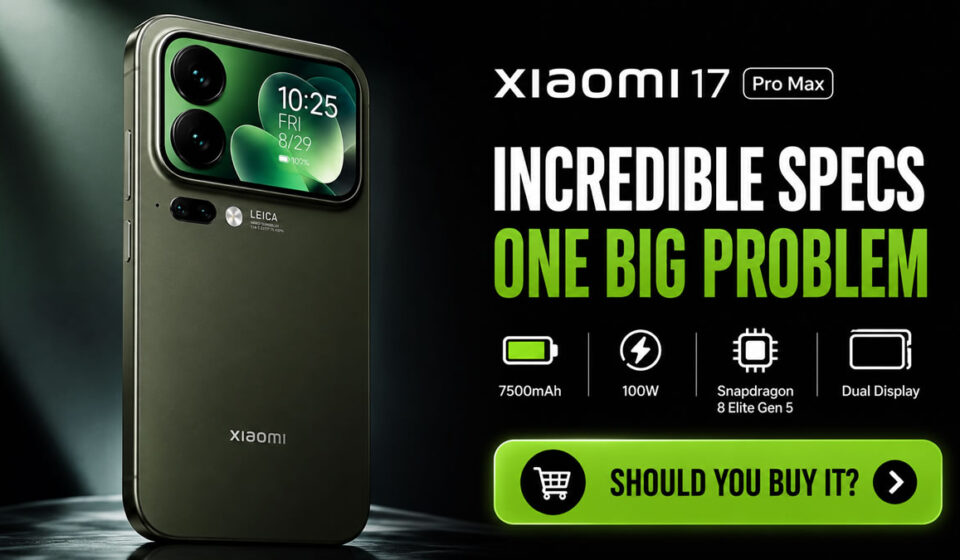
Xiaomi 17 Pro Max Has Incredible Specs and One Big Problem
Xiaomi 17 Pro Max is one of the most interesting phones launched in 2025. It has a 7,500 mAh battery, a second screen on the back, the fastest Qualcomm chip, and 100W wired charging. On paper, it destroys most rivals at its price point. In practice, there is one thing that stops most people from buying it. It is a China only phone, and that changes everything.
The Second Screen Is Not a Gimmick
The Xiaomi 17 Pro Max has a 2.9 inch secondary LTPO OLED display on the back. That sounds like a marketing trick. It is not. You can use it to frame selfies with the main rear cameras, check notifications, control music, and preview messages. GSMArena called it “not a gimmick” after hands on time with the device. It works in a real and practical way that flip phones have proven for years.
The Battery Is Genuinely Special
The 7,500 mAh battery in the Xiaomi 17 Pro Max is one of the biggest ever packed into a phone this thin. In GSMArena’s testing, it hit a 20:50 hours Active Use Score. That puts it right up there with the best battery performers on the market. Web browsing and video playback scores were especially strong. Even gaming, which is the most battery demanding use case, lasted impressively long.
Nintendo Switch 2: The $500 Console Nobody Warned You About
100W Charging Is Real and Fast
Xiaomi claims the phone goes from 0 to 100 percent in 35 minutes using its 100W wired charger. A reviewer at Beebom found that claim to be accurate in real world use, with a phone at 50 percent charging to full in about 15 minutes. The phone also supports 50W wireless charging. That is faster wireless charging than most phones offer on a wired connection.
The Chip Inside Is the Fastest Available
The Snapdragon 8 Elite Gen 5 is a 3 nm chip from TSMC. The Xiaomi 17 Pro Max was one of the first phones in the world to ship with it. Daily performance is fast and smooth across all tasks. Browsing, multitasking, and app switching all feel sharp. The chip also shows improved efficiency, which helps explain the strong battery numbers.
Gaming Performance Has a Small Weakness
Under sustained gaming load, the phone shows some throttling in benchmark stress tests. This did not hurt real game performance in titles like Genshin Impact at the highest settings, but GSMArena noted that the phone struggles to fully use the Snapdragon 8 Elite Gen 5’s potential in every scenario. It is not a dealbreaker. It is worth knowing that the phone does not push the chip as hard as some rivals do.
The Cameras Are Good But Not Great
The triple 50 MP camera system is Leica tuned. The main sensor uses the Light Fusion 950L. In good light, it delivers solid results. The problem sits with the 5x periscope telephoto. GSMArena described the camera system as uninspiring, specifically calling out the 5x telephoto as a miss. The f/3.0 aperture on the telephoto lens means it struggles indoors and in low light. Competitors from Oppo and Vivo offer bigger telephoto sensors at similar prices in the Chinese market.
Night Mode and Consistency Are Weak Points
Real world testers found the camera to be inconsistent. Portrait mode had edge detection errors in a meaningful portion of shots. Night mode washed out shadows. Daylight shots can look over-sharpened. The Leica branding adds color science and tuning, but it cannot fix hardware limitations on the telephoto. If you want the best camera phone in this price range, the iPhone 17 Pro Max and Samsung Galaxy S25 Ultra are objectively stronger options according to independent reviewers.
GTA 6 Preorder Retail Pricing Traps Exposed 2026
HyperOS 3 Is Powerful But Comes With Baggage
The Xiaomi 17 Pro Max runs HyperOS 3.0 based on Android 16. It is the first phone GSMArena tested running this version of the OS. The UI is smooth and the animations are clean. However, the Chinese version of the ROM has real limitations for international users. It only supports Chinese and English. Google Discover, Location History in Maps, Android Auto, Google Assistant voice activation, and QuickShare between Android phones are all absent. These are not minor missing features.
Importing This Phone Creates Serious Software Problems
Xiaomi will not be releasing the Xiaomi 17 Pro Max in global markets based on multiple confirmed reports. Technical documentation confirms no global HyperOS 3 build exists for this device. If you import one from China, you get the China ROM. That means no native Google Mobile Services integration. Apps like Gmail and WhatsApp suffer from delayed or missed push notifications because Google’s background notification system does not run properly. You have to manually whitelist each app’s autostart permissions, and even that does not always fix the issue.
Bootloader Unlocking Is Now Banned
Bootloader unlocking for China region Xiaomi devices has been effectively banned as of 2026. This means you cannot flash a global or custom ROM to fix the software problems. The only firmware you can run is the one that ships with the phone. If the China ROM does not work for you, there is no technical workaround available.
Network Issues Outside China Are Real
The China model lacks LTE Band 20 support. This causes significant signal loss in European rural areas and inside buildings. There is no eSIM support and no VoLTE outside of China’s networks. Android Auto and Google Wallet do not work on non-global firmware. These are not edge cases. They are daily use problems for anyone living outside mainland China.
The Real Price After Import Is Much Higher
The Xiaomi 17 Pro Max has an official Chinese price starting at approximately 720 euros for the 12GB/512GB model based on PhoneArena comparison data. That sounds competitive. Once you factor in import taxes, shipping, and the risk of customs fees, the real cost to buyers in Europe or North America climbs significantly. One reviewer noted total costs pushed toward $1,500. At that price, the phone is no longer cheap. It competes directly with the iPhone 17 Pro Max and Samsung Galaxy S25 Ultra on price while offering less software reliability.
Nintendo Switch 2 Release Schedule Traps Exposed
Xiaomi 17 Pro Max vs HyperOS 3 Chinese ROM in 2026
What Xiaomi Advertises vs What You Actually Get
| Feature | Xiaomi’s Marketing Claim | China ROM Reality | Verdict for Global Buyers |
| Battery and charging | 7500 mAh with 35 min 100W full charge | Confirmed accurate by independent reviewers | Strong genuine strength |
| Secondary display | Practical selfie and notification tool | Works as described; not a gimmick per reviewers | Real added value |
| Software and apps | HyperOS 3 based on Android 16 | China ROM only; no GMS; no Android Auto; no Google Assistant voice | Serious problem for non-China users |
| Global availability | Full flagship phone available globally | Confirmed China only by HyperOS code and Xiaomi sources; no global ROM exists | Do not import unless you accept the limitations |
What About the Xiaomi 17 Ultra Instead
If you want a Xiaomi flagship that actually ships globally, the Xiaomi 17 Ultra is the answer. It launched at MWC 2026 on February 28 and has been available in the UK and most Western territories since then. The 17 Ultra has a proper global ROM with full Google Services, global network bands, and a confirmed international warranty. It does not have the secondary rear display or the 7,500 mAh battery, but it works as a daily driver without the software headaches.
Practical Steps Before You Consider Importing
First, ask yourself whether you use Android Auto, Google Wallet, Google Maps navigation, or any app that depends on Google push notifications. If yes, the Xiaomi 17 Pro Max China ROM will frustrate you daily. Second, calculate your real all-in cost including import taxes and shipping before comparing the price to a Galaxy or iPhone. Third, check whether the Xiaomi 17 Ultra meets your needs before committing to an import.
Xiaomi has not published any global release date or announcement for the Xiaomi 17 Pro Max. The company’s own official channels reflect only the China launch. Fourth, if you do decide to import, join the Xiaomi community forums to understand exactly which workarounds exist for notification and connectivity issues before the phone arrives.
The FTC provides guidance on smartphone consumer rights in the US, including what protections exist when buying imported devices without domestic warranty coverage.
The Xiaomi 17 Pro Max Is Worth Knowing About
This phone is not a disappointment. It is an impressive piece of hardware from a company pushing genuinely creative ideas. The secondary display works. The battery is outstanding. The charging speed is best in class. The design is sharp and the build quality is premium with an IP68 rating and glass and aluminum construction.
The telephoto camera is the weakest hardware link. HyperOS 3 in its China form is the biggest software barrier. Neither of these issues changes the fact that if Xiaomi releases a global version of the Xiaomi 17 Pro Max with a full Google ecosystem, it would be a serious contender at any price.
For now, GSMArena summarizes the situation clearly: the phone is a well-rounded flagship without many weak points, but the cameras fall short of the best options, and it remains a China only device for the foreseeable future.
Xiaomi 17 Pro Max Is Amazing Hardware Stuck in China
The Xiaomi 17 Pro Max sets real benchmarks in battery life, charging speed, and creative hardware design. It also runs software that does not work properly outside China, ships with no global release date, and climbs to iPhone prices once you add import costs. Hardware alone does not make a daily driver. Know that before you order one online.