

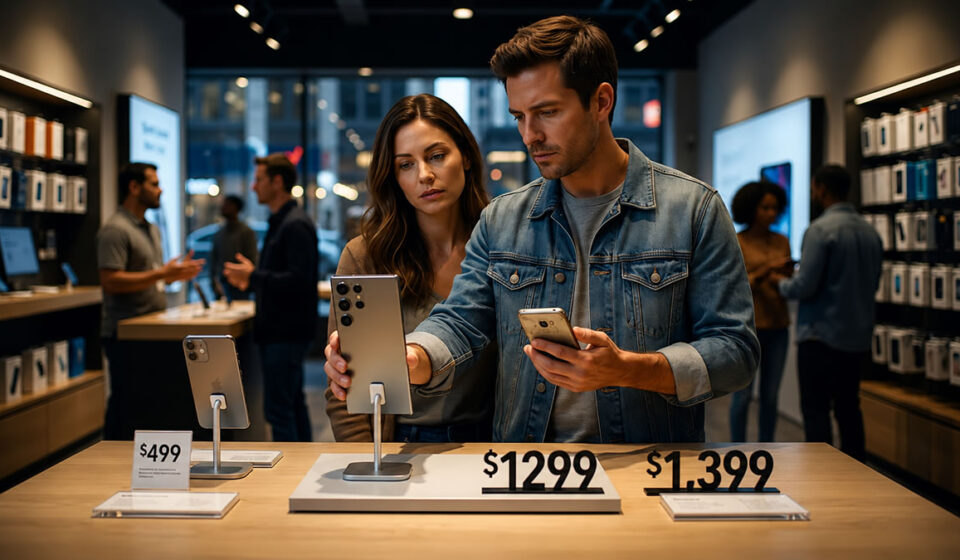
Overpriced Smartphones Are the Biggest Consumer Scam of 2026
Walk into a carrier store right now. The flagship wall starts at $999. The premium tier hits $1,199. The top of the line pushes past $1,400 before you add a case, a screen protector, or a monthly installment fee. Overpriced smartphones have become the new normal in America. Prices have nearly doubled in a decade. And the justification from phone makers gets thinner every year.
The average American household now spends more on phones than on electricity. Let that sink in. This is a Reality Check investigation. We are going to break down exactly what you are buying, what you are actually getting, and whether any flagship phone sold in 2026 honestly deserves its price tag. Spoiler: a few do. Most do not.
What Phone Makers Want You to Believe
Every flagship launch follows the same playbook. Apple tells you the iPhone 17 Pro is a leap forward in intelligence, camera capability, and processing power. Samsung says the Galaxy S25 Ultra is a productivity device and a professional camera system rolled into one. Google positions the Pixel 10 Pro as the smartest phone ever made.
Each brand leans hard on three core promises in 2026:
- AI features that transform how you work and communicate
- Camera systems that rival professional photography equipment
- Processing power built for the next five years
These promises sound compelling. They are designed to. But pulling back the marketing layer reveals a very different picture for most buyers.
The Reality Check: What $1,200 Actually Buys You in 2026
The Camera Argument Falls Apart Fast
Camera quality is the number one justification for flagship pricing. It is also the most overstated one. The iPhone 17 Pro and Galaxy S25 Ultra do produce excellent photos. Nobody is disputing that. But here is the honest question: can you tell the difference in your actual life?
Independent testing from publications including DXOMARK, consistently shows that phones priced between $400 and $600 now score within a narrow range of $1,200 flagships on standard photo tests.
The gap exists. It shows up in low-light professional scenarios and extreme zoom ranges. For the vast majority of users taking photos at birthday parties, restaurants, and outdoor events, that gap is nearly invisible at normal viewing sizes. You are paying $600 extra for a camera difference that only matters in controlled tests.
The AI Feature Gap Is Closing at Every Price Point
Phone makers leaned even harder into AI positioning in 2026. Every flagship promises smarter assistants, better on-device processing, and AI tools that change how you use your phone. But here is what the marketing does not emphasize. Google’s Gemini assistant now runs on the Pixel 9a at $499. Apple Intelligence features rolled out to iPhone 15 models are still in use. Samsung’s Galaxy AI works on the Galaxy A55 at under $500.
The AI features driving premium pricing in 2025 migrated down the product line within 12 months. That pattern will repeat in 2026 with whatever premium AI feature launches this fall. Buying a flagship for its AI features is buying tomorrow’s midrange feature at flagship prices today.
Processor Upgrades Are Real but Irrelevant for Most Users
The Apple A19 Pro and Qualcomm Snapdragon 8 Elite 2 inside 2026 flagships are genuinely impressive chips. They are also dramatically overpowered for what most Americans use their phones for. Texting, social media, streaming video, navigation, and casual photography do not push a flagship chip beyond 15 percent of its capacity.
Benchmark tests confirm this. Real-world usage data confirms this. Game developers and video editors who render content on their phone can genuinely use that extra processing headroom. That is a real niche. It is not the average consumer standing in line at an Apple Store.
Overpriced Smartphones: The Price Versus Value Breakdown
| Phone | 2026 Price | Key Selling Point | Midrange Alternative | Alternative Price |
| iPhone 17 Pro Max | $1,399 | Camera, A19 chip, Apple Intelligence | iPhone 16 | $699 |
| Samsung Galaxy S25 Ultra | $1,299 | S Pen, 200MP camera, Galaxy AI | Samsung Galaxy A55 | $449 |
| Google Pixel 10 Pro | $1,099 | Gemini AI, camera, software updates | Google Pixel 9a | $499 |
| OnePlus 13T Pro | $899 | Fast charging, clean Android, speed | OnePlus Nord 4 | $399 |
| Sony Xperia 1 VII | $1,299 | Manual camera controls, display quality | Sony Xperia 10 VII | $549 |
The price gap between flagship and midrange phones averages $650 in 2026. That is $650 for incremental improvements that most users will never use or notice.
Real World Testing: Where Flagships Win and Where They Do Not
Where Premium Phones Genuinely Deliver
Let us be fair. Some flagship features are worth paying for.
- Sustained performance over time. Premium chips and better thermal management mean flagships hold their speed better after two or three years. Budget phones tend to slow down faster.
- Software support length. Apple promises seven years of iOS updates. Google now offers seven years for Pixel 9 and newer. Samsung offers seven years on the Galaxy S series. Budget brands often stop at two or three years.
- Build quality and repairability. Flagship glass and aluminum builds are more durable. Repairability has improved slightly across brands following pressure from right-to-repair legislation.
- Satellite communication. Emergency satellite messaging launched on premium iPhones and is now expanding across flagships. This is a genuine safety feature not yet available across all midrange devices.
Where the Premium Completely Fails to Justify the Price
- Display improvements are invisible to most eyes. The jump from a $500 phone display to a $1,300 phone display involves refresh rate differences and brightness levels that most users cannot distinguish in daily use.
- Zoom cameras collect dust. Periscope zoom lenses in ultra-premium phones offer 5x to 10x optical zoom. Research consistently shows most users zoom in at 2x or less in daily shooting.
- Storage tiers are a separate scam. Paying $100 to $200 more to move from 256GB to 512GB is a markup that exceeds the actual cost of flash storage by a massive margin. This is a profit mechanism dressed as a feature choice.
- Accessories are not included. Flagships at $1,200 ship without a charger in the box. Apple and Samsung both removed chargers from flagship packaging. A replacement fast charger costs $30 to $50 extra.
The Privacy Side of Premium Pricing
Overpriced smartphones also carry a data collection reality that premium marketing glosses over.
You Pay More and Still Get Tracked
Buying a $1,300 phone does not buy you better privacy by default.
- Samsung collects usage data, app activity, and behavioral patterns through its Galaxy ecosystem. Several Galaxy AI features route data through Google servers, meaning two companies receive your data simultaneously.
- Google Pixel phones offer strong privacy dashboard tools. But Google’s core business model is advertising built on data. Using a Pixel means trusting a company whose revenue depends on understanding your behavior.
- Apple remains the strongest default privacy option among major brands. Their App Tracking Transparency framework and on-device processing commitments are more substantive than competitors.
But even Apple collects diagnostic data, iCloud content, and Siri query logs by default. Premium pricing does not equal premium privacy without adjusting your settings.
The Upgrade Cycle Surveillance Model
Phone makers benefit financially from annual upgrades. Trade-in programs, carrier installment plans, and annual launch events create a deliberate upgrade pressure cycle. That cycle generates more device data, more platform engagement, and more advertising revenue. The business model of overpriced smartphones is not just about hardware margin.
It is continued access to your behavioral data as a loyal ecosystem member. Understanding that model helps explain why the marketing always makes your current phone feel suddenly inadequate.
Pros and Cons: The Honest 2026 Breakdown
Genuine Strengths of 2026 Flagships
- Seven-year software update commitments protect long-term investment
- Superior sustained performance over three or more years of use
- Emergency satellite communication adds real safety value
- Best-in-class low-light photography is genuinely ahead of budget options
- Premium build quality reduces replacement risk over time
- Ecosystem integration for users deep in Apple or Google platforms is seamless
Real Weaknesses That Justify the “Overpriced” Label
- Core features are now available on phones costing $400 to $600 less
- Storage upgrade pricing represents an extreme profit margin over actual cost
- Chargers and accessories no longer included at any flagship price point
- AI features marketed as exclusive migrate to midrange within 12 months
- Camera improvements beyond 2x zoom deliver minimal daily use value
- Annual upgrade cycles push hardware that rarely improves daily tasks meaningfully
Hidden Tradeoffs Worth Knowing
- Carrier installment plans disguise the total cost and lock you into upgrade cycles
- Trade-in values depreciate rapidly, often within six months of a new launch
- Premium phone repair costs are significantly higher than midrange alternatives
- Battery replacement on sealed flagship phones requires professional service
2026 Value Comparison: What Your Money Actually Buys
| Budget | Best Option | What You Get | What You Miss |
| Under $300 | Motorola Moto G Power 5G | Reliable daily use, long battery life | Slower chip, basic camera |
| $300 to $500 | Google Pixel 9a | Excellent AI features, clean Android, great camera | Some hardware refinements |
| $500 to $700 | Samsung Galaxy A55 or iPhone 16 | Strong performance, good camera, long support | Periscope zoom, top-tier chip |
| $700 to $900 | iPhone 16 Pro or Pixel 10 | Near flagship performance and camera | Minor premium features |
| Over $1,000 | iPhone 17 Pro Max or Galaxy S25 Ultra | Peak camera, satellite features, max performance | Real value for very specific users only |
Verdict: Buy or Bye?
Buy — For a Narrow Group of Real Use Cases
If you are a content creator, professional photographer, or small business owner who depends on your phone’s camera for revenue, the flagship tier makes economic sense. The quality difference matters when it directly affects your income. If you plan to keep your phone for five or more years, investing in premium hardware and long software support has genuine long-term value. The math works if you use the device fully and hold it for the full update cycle.
Bye — For Most American Consumers in 2026
If you use your phone for everyday tasks, the $649 to $749 sweet spot delivers 85 to 90 percent of what a $1,300 flagship offers at roughly half the price. The overpriced smartphones market in 2026 relies on two things: effective marketing and the human desire to own the best available option. Neither of those is a good reason to spend an extra $600.
The iPhone 16 and Pixel 9a represent the real sweet spot this year. Both offer strong cameras, solid AI features, long software support, and respectable build quality at genuinely reasonable prices.
Final Thought
Overpriced smartphones are not a new problem. But the gap between what flagships cost and what they meaningfully deliver has never been wider than in 2026. The industry has perfected the art of making incremental improvement feel revolutionary. They have built installment plans that hide the true cost. They have created ecosystems that make switching feel painful. And they refresh features annually just fast enough to keep upgrade anxiety alive.
You deserve better than that. The smartest phone purchase in 2026 is not the one with the most impressive launch event. It is the one that does everything you actually need for the next three years without draining your bank account to get there. Overpriced smartphones will always exist. The question is whether you choose to fund them.