

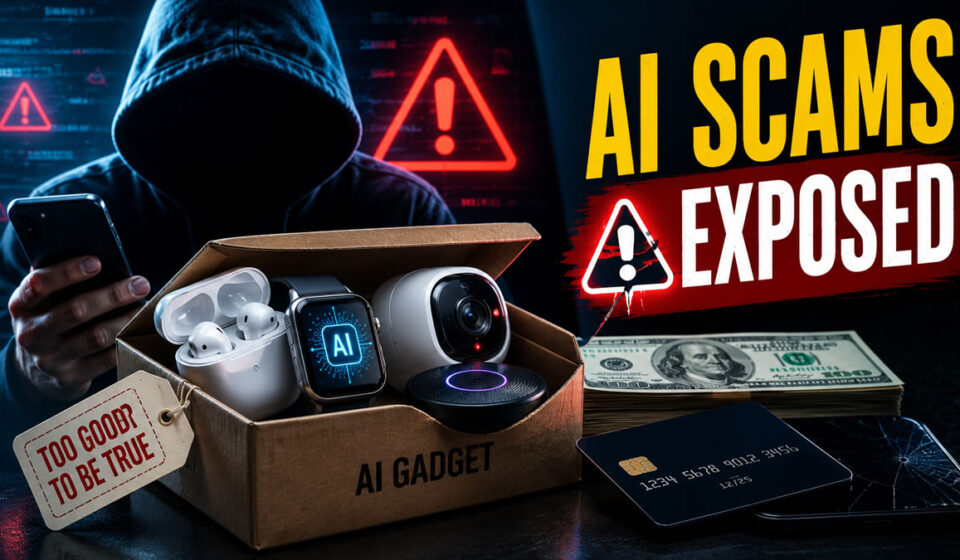
AI Gadget Scams Are Draining Millions in 2026
AI gadget scams are now one of the fastest-growing fraud categories on the planet. In May 2026, the evidence is no longer anecdotal. Consumers lost over $12.5 billion to AI-assisted fraud in 2025 alone. The gadgets on your screen may look revolutionary. However, many are built on nothing but buzzwords and bold lies.
This investigation exposes the full picture. It names the tactics, reveals the financial damage, and gives you a clear exit strategy.
The “AI-Powered” Label Is Now the World’s Most Abused Marketing Phrase
Every week, new gadgets flood the market. They all share the same promise. They claim to use “cutting-edge AI” to transform your life. Moreover, they charge a premium price to match that promise.
However, the FTC’s Operation AI Comply found a disturbing pattern. Companies routinely slap “AI” on products with no real intelligence inside. The agency has sued multiple firms for exactly this. One AI content detection tool claimed 98% accuracy. Independent testing showed it performed no better than a coin toss.
Additionally, the FTC Commissioner confirmed in April 2026 that the agency will “aggressively root out AI-powered frauds.” The message is clear. Regulators know the problem is massive. Consequently, enforcement is accelerating across the board.
The term for this tactic is “AI washing.” It mirrors the old pattern of greenwashing in sustainability. Companies add the AI label to attract investors and consumers alike. Furthermore, it works because most buyers cannot verify the claims themselves.
Therefore, the label “AI-powered” now means almost nothing without independent proof. This is the core of the AI gadget scams crisis in 2026.
AI Gadget Scams: The Financial Trap Behind the Flashy Packaging
The money lost to AI gadget scams is staggering. Consumers in the US reported $12.5 billion in total fraud losses in 2025. Furthermore, Experian’s 2026 Future of Fraud Forecast declared this year a “tipping point” for AI-enabled fraud.
The FTC’s own data tells a devastating story. One scheme defrauded consumers of at least $25 million. It sold fake AI-powered online storefronts. Consequently, a federal court stepped in to shut it down. Another company, Cleo AI, paid $17 million in settlements for misleading cash advance promises.
However, the gadget-specific fraud is even more creative. Scammers now sell fake AI devices through social media ads. These ads use deepfake celebrity endorsements. The influencer in the video never agreed to promote the product. Moreover, the device itself often ships as a cheap, unbranded piece of plastic.
Additionally, AI-generated fake storefronts mimic real brands perfectly. Deepfake detection firm Pindrop found that three in ten retail fraud attempts are now AI-generated. Furthermore, some large retail chains report over 1,000 AI bot scam calls per day.
Therefore, the financial trap is not just about one bad purchase. It is a full ecosystem of deception. Consequently, victims often lose money on shipping, face identity theft, and struggle to get refunds.
2026 Reality Table: What They Claim vs. What You Actually Get
| Marketing Claim | May 2026 Reality |
| “Powered by advanced AI” | Generic chip with no machine learning capability |
| “98% accurate AI detection” | FTC found performance equal to a coin flip |
| “AI earbuds with real-time translation” | Basic Bluetooth device with no live translation |
| “Endorsed by [Celebrity Name]” | Deepfake video; celebrity never agreed to promote |
| “Earn passive income with AI tools” | FTC sued operators; consumers lost $25 million |
| “Quantum AI investment returns” | Buzzword scam with no real underlying technology |
| “AI security camera with facial recognition” | Standard motion sensor; no AI core inside |
| “Clinically approved AI health gadget” | No clinical trial conducted or registered anywhere |
AI Gadget Scams Are Now a Surveillance Crisis in Disguise
Beyond the financial damage, AI gadget scams carry a second, darker threat. Many fake AI devices actively collect your data. Moreover, they do it without your knowledge or meaningful consent.
Group-IB’s 2026 research confirmed that AI scam operations now combine synthetic voices, data harvesting, and live AI responders. Consequently, a fake gadget is rarely just a useless product. It is often a data collection tool built to look innocent.
Additionally, Malwarebytes documented a campaign called “Pushpaganda” in April 2026. Operators used AI-generated articles about fake gadgets. They pushed victims toward malicious websites. Furthermore, a single tap subscribed victims to a scam notification channel. Over time, victims received a stream of fake investment and tech support frauds.
Therefore, the risk is not limited to a bad purchase. Moreover, connecting a fake AI device to your home network opens a door. Scammers can access your contacts, location data, and even your financial applications.
Android’s 2026 security roadmap directly addressed this pattern. The update introduced verified call systems and on-device AI threat detection. Consequently, major operating systems are fighting back hard. However, fake gadgets keep evolving just as fast.
Furthermore, the World Economic Forum’s Global Cybersecurity Outlook 2026 confirmed that 73% of organizations faced AI-enabled fraud in 2025. For individuals buying consumer gadgets, the personal risk is equally serious. Therefore, every unverified AI device you connect to your network is a potential surveillance entry point.
Protecting Yourself from AI Gadget Scams Starts Right Now
The good news is that protection is absolutely possible. Moreover, the steps are practical and require no technical expertise. Follow this clear process before your next AI gadget purchase.
Step 1: Search the FTC complaint database first. Visit ReportFraud.ftc.gov and search the brand name. Consequently, you will find active complaints and warnings before spending a single dollar.
Step 2: Demand third-party test results. Ask for independent lab verification, not just the brand’s own claims. Furthermore, check whether the “AI” feature has a verifiable model name or patent number attached.
Step 3: Reverse search every celebrity endorsement. Use Google Image search on the ad thumbnail. Additionally, check the celebrity’s verified social accounts for any real mention of the product. A genuine endorsement appears on their official channels.
Step 4: Read the refund and return policy with care. Scam gadget sellers routinely use complex refund clauses to trap buyers. Moreover, no refund window is a major red flag. Therefore, always read the fine print before checkout.
Step 5: Never connect unknown devices to your main home network. Use a separate guest network for any new, unverified device. Consequently, even if the gadget is compromised, your primary devices stay protected.
Step 6: Report suspicious products immediately. Use ReportFraud.ftc.gov and your state’s consumer protection office. Furthermore, reporting helps regulators build cases faster. Therefore, your complaint directly protects the next potential victim.
The Final Verdict: Buy the Real Deal or Walk Away
The AI gadget market in May 2026 is split in two. On one side, legitimate products from verified manufacturers do exist. They publish genuine test data. Moreover, they stand behind their claims in court and in public.
However, the other side is a sprawling fraud ecosystem. It is built on deepfake ads, AI-generated reviews, and zero accountability. Consequently, the burden of proof now falls entirely on the buyer.
Additionally, the regulatory environment is tightening fast. The FTC is actively pursuing AI washers. Furthermore, Android 17’s new security layer blocks many data-harvesting gadgets at the network level. Therefore, the legal and technical walls around AI gadget scams are rising.
The buy signal is clear: verified specs, real lab tests, transparent data policies, and a genuine refund guarantee. The bye signal is equally clear: vague “AI-powered” claims, celebrity deepfakes, no verifiable testing, and refund traps.
Moreover, do not let urgency push you into a bad decision. Scammers design countdown timers and limited-offer alerts to override your judgment. Therefore, slow down. Consequently, a ten-minute research session can save you hundreds of dollars and protect your personal data.
The One Truth Every Buyer Needs in 2026
If a brand cannot show you real, independent test results for its AI claims, the gadget is not truly AI-powered. It is powered by your trust alone. Furthermore, in 2026, your trust is worth billions of dollars to scammers. Therefore, protect it like the valuable asset it is. Consequently, the single most powerful weapon against AI gadget scams is a patient, informed, and unhurried buyer who demands real proof.