

Smart Home Privacy Breaches Are Turning American Living Rooms Into Open Data Feeds
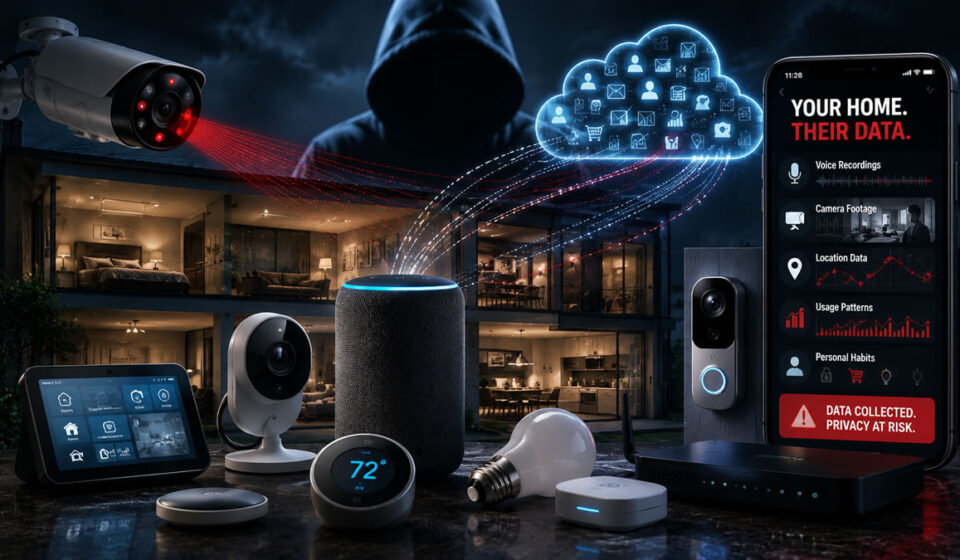
Your smart home is not just a convenience. For dozens of corporations, it is a permanent window into your private life. By May 2026, the average American household will connect 22 devices to its home network. Smart speakers, thermostats, doorbells, TVs, baby monitors, robot vacuums, and light bulbs all generate behavioral data around the clock.
Smart home privacy breaches have escalated from occasional headlines into a documented, systemic crisis. And unlike a stolen credit card number, this kind of exposure never fully closes. The data is already out. The profiles already exist. The buyers are already using them.
The Connected Home Promise That Never Mentioned the Fine Print
Every major smart home brand entered your house with an irresistible pitch.
Amazon told you that Alexa would simplify your daily routine, manage your shopping, control your lights, and act as a household assistant available at any moment. Google positioned the Nest ecosystem as a safer, smarter, more energy-efficient home built around your family. Ring promised community-level security through a network of connected cameras that would put you in control of your property. Apple positioned HomeKit as the privacy-first alternative that kept everything local and encrypted.
The shared message was warm and reassuring. Smart technology would save you time, protect your home, cut your energy bills, and give you complete control. What none of these brands placed anywhere near the front page of their marketing was the actual scope of data collection running silently beneath every voice command, motion alert, and thermostat adjustment.
Smart Home Privacy Breaches Expose What Your Devices Have Been Doing All Along
The Amazon Alexa Data Trail Is Wider Than Most Users Realize
Amazon’s Alexa devices recorded voice clips even when the wake word was not used. Amazon acknowledged in 2023 Congressional testimony that employees and contractors had access to user voice recordings for quality review purposes. By May 2026, the core architecture had not fundamentally changed.
Every Alexa interaction feeds Amazon’s advertising intelligence engine. Your device usage patterns, shopping queries, home routine data, and household activity logs all contribute to a behavioral profile that powers Amazon’s $46 billion annual advertising business. Buying an Echo is not just buying a speaker. It is installing an Amazon data collection node inside your home, permanently connected to the most sophisticated retail advertising system ever built.
Ring Doorbell Data Sharing With Law Enforcement Crossed a Critical Line
Between 2019 and 2023, Ring provided footage to law enforcement agencies without user consent on at least 11 documented occasions, confirmed through Congressional investigation. Amazon, which owns Ring, settled related concerns with the Federal Trade Commission in 2023 for $5.8 million over Smart Home Privacy Breaches tied to employee access to private footage and inadequate security practices.
By May 2026, Ring updated its law enforcement data sharing policies following intense regulatory pressure. However, their Neighbors app continues to aggregate community-submitted footage and behavioral reports. The platform’s network effect means your footage contributes to a surveillance database that extends well beyond your property line into your broader neighborhood without meaningful oversight.
Google Nest Audio and Video Logs Feed the Core Ad Business
Google processes Nest device interactions through its core infrastructure.
Your Nest thermostat schedules, your Nest camera activity logs, and your Google Home voice queries all route through Google’s data systems. Google’s privacy documentation states that smart home device data is not used to target ads. Independent privacy researchers at Mozilla Foundation flagged in their 2025 Privacy Not Included report that the practical separation between Google’s smart home data and its advertising infrastructure is difficult to verify independently because both systems run on the same underlying cloud platform.
The 2026 Breach Landscape: IoT Devices Are the Weakest Link
Smart home devices represent the most vulnerable category in home network security.
In the first quarter of 2026, cybersecurity researchers at Bitdefender reported a 38 percent increase in attacks targeting IoT devices compared to the same period in 2025. Smart cameras, baby monitors, and older smart speakers running outdated firmware were the most frequently compromised categories. Once an attacker gains access to one poorly secured device, they can often pivot across the entire home network to reach laptops, phones, and financial accounts on the same Wi-Fi connection.
Budget smart home devices, particularly those manufactured in China and sold through the Amazon marketplace, consistently receive the lowest security ratings. Many ships with default passwords that users never change. Others run on firmware that the manufacturer stops updating within 18 months of sale, leaving documented vulnerabilities permanently unpatched.
2026 Reality Table: Marketing Claim vs. The May 2026 Reality
| Marketing Claim | The May 2026 Reality |
| “Alexa only listens when you say the wake word” | Amazon acknowledged false activations; voice clips reviewed by human contractors |
| “Ring puts you in control of your home security” | Footage shared with law enforcement without consent on 11+ confirmed occasions |
| “Google Nest protects your family’s privacy” | All interactions processed through Google cloud; independent verification of ad separation unavailable |
| “Apple HomeKit keeps everything local and encrypted” | Local processing is real; third-party HomeKit accessories vary widely in their own data practices |
| “Your smart home data stays in your home” | Data flows to manufacturer servers, third-party analytics firms, and advertising platforms |
| “Smart devices get regular security updates” | Budget IoT devices frequently abandoned within 18 months; unpatched vulnerabilities persist |
| “Voice data is only used to improve the product” | Alexa interaction data informs Amazon’s $46B advertising business |
| “These devices are secure against hackers” | IoT attacks up 38% in Q1 2026; smart cameras and baby monitors among most compromised devices |
| “Your footage is private and encrypted” | Ring FTC settlement confirmed inadequate security practices and unauthorized employee access |
| “Smart home features save you money” | Average household pays $180 to $360 per year in combined smart home subscriptions beyond hardware cost |
The Surveillance Architecture Running Silently Through Your Home Network
Your Home Wi-Fi Is a Data Highway With No Toll Booth
Every smart device you connect to your home network adds a new channel of outbound data transmission.
Most consumers have no visibility into what their devices send, where it goes, or how often it leaves their network. A standard home router provides no traffic monitoring tools for average users. A smart TV, a robot vacuum, a baby monitor, and a smart thermostat can collectively generate hundreds of outbound data connections per day without triggering any alert or requiring any user interaction. Smart home privacy breaches begin not with dramatic hacks but with the quiet, continuous transmission of behavioral data that manufacturers designed their products to send from day one.
Read More About: AI Pin Subscription Traps 2026
Baby Monitors Carry the Highest Personal Risk Category
The data generated by smart baby monitors represents some of the most sensitive information a company could possess about a household.
Room audio, sleep schedule data, infant movement patterns, and parent conversation snippets all flow through the servers of companies that have no specific regulatory obligation under current USA law to protect this category of data. In 2025, researchers at Consumer Reports tested 15 popular smart baby monitors and found that 11 transmitted data to third-party analytics servers. Four had exploitable security vulnerabilities in their companion apps. Two used default credentials that could not be changed by the user.
The Smart Vacuum Floor Plan Problem
This is one of the least discussed Smart Home Privacy Breaches and one of the most consequential.
Modern robot vacuums from iRobot (Roomba), Roborock, and Ecovacs build detailed floor plans of your home during their mapping process. iRobot confirmed in 2022 that they had considered sharing floor plan data with third parties. Following acquisition by Amazon in 2023, that data relationship became part of Amazon’s broader ecosystem. By May 2026 Amazon had integrated Roomba data with Alexa routines, meaning the floor plan of your home exists on Amazon’s servers and informs how their ecosystem understands your household layout.
Smart Home Privacy Breaches Through Third-Party App Vulnerabilities
The weakest link in most smart home setups is not the primary device from a major brand.
It is the third-party app or skill that users install to extend functionality. Amazon’s Alexa skills, Google’s Actions, and Apple’s HomeKit-adjacent apps vary dramatically in their security practices. Many are built by small developers with minimal security review. A compromised third-party skill can access voice history, device status, and home automation routines with permissions that users granted during setup and never revisited.
Taking Back Control: Practical Steps to Secure Your Smart Home Today
Immediate Actions That Cost Nothing
Step 1: Audit every device on your home network right now. Log into your router’s admin panel (usually at 192.168.1.1 or 192.168.0.1 in your browser). Find the connected devices list. Write down every device shown. Delete anything you do not recognize or no longer use.
Step 2: Change every default password on every device. Default credentials are the number one entry point for IoT attacks. Every smart camera, baby monitor, doorbell, and smart speaker should have a unique, strong password. Use a password manager like Bitwarden (free) or 1Password to generate and store them.
Step 3: Update firmware on all devices immediately. Open the app for each smart device. Navigate to settings and check for firmware updates. Enable automatic updates where available. If a device has not received an update in over 12 months, consider whether it belongs on your network.
Step 4: Delete your Alexa voice history and disable future storage. Open the Alexa app. Go to More, then Settings, then Alexa Privacy, then Review Voice History. Delete all recordings. Then select Manage Your Alexa Data and set voice recordings to “Don’t save recordings.” Repeat this quarterly because Amazon occasionally resets these settings through app updates.
Step 5: Turn off Google Assistant audio activity saving. Go to myactivity.google.com. Select Web and App Activity. Turn off the option to include audio recordings. Delete all previous audio activity from this same settings panel.
Read More About: Overpriced Smartphones Are the Biggest Consumer Scam of 2026
Network-Level Protection Steps
Step 6: Create a separate IoT network for all smart home devices. Most modern routers support a guest network or VLAN setup. Put every smart device, smart TV, and IoT gadget on this isolated network. Keep your phones, laptops, and computers on the main network. This prevents a compromised smart device from accessing your personal files or financial accounts.
Step 7: Consider a privacy-focused DNS service. Setting your router’s DNS to NextDNS or Pi-hole (free, self-hosted) blocks known tracking and advertising domains at the network level. This stops data collection attempts before they leave your home, across every connected device simultaneously.
Step 8: Disable microphones on devices you use primarily for other functions. Your smart TV almost certainly has a microphone for voice control. If you never use voice control on your TV, go into accessibility or voice settings and disable the microphone entirely. The same applies to smart speakers in rooms where you have sensitive conversations.
Smarter Buying Decisions Going Forward
Step 9: Check Mozilla’s Privacy Not Included database before any smart home purchase. Mozilla’s Privacy Not Included guide rates hundreds of smart home devices on data collection, security practices, and vulnerability history. It is free, updated regularly, and takes 30 seconds to check.
Step 10: Favor devices that work offline or locally. Home Assistant is a free, open-source smart home platform that runs entirely on local hardware inside your home. It supports thousands of devices and sends zero data to external servers by design. Setting it up requires modest technical comfort, but the privacy difference is absolute.
Strengths, Weaknesses, and the Hidden Costs Most Buyers Never See
Where Smart Home Technology Genuinely Delivers Value
- Energy savings from smart thermostats are documented and real; Nest and Ecobee users report 10 to 15 percent annual HVAC savings
- Smart doorbells and cameras provide genuine security deterrence and real-time awareness for families
- Accessibility benefits for elderly users and people with disabilities are meaningful and underreported
- Home automation routines reduce friction for daily tasks in ways that measurably improve quality of life
- Apple HomeKit with local processing provides meaningfully stronger privacy than most competitor platforms
- Smart smoke and carbon monoxide detectors with cellular backup can save lives in ways standard detectors cannot
Where the Risks Outweigh the Convenience for Most Households
- Always-on microphones in smart speakers create a permanent audio surveillance risk with no guaranteed off state
- IoT devices represent the most attacked category on home networks as of Q1 2026
- Manufacturer data collection continues after purchase with no user visibility into what is sent or sold
- Budget smart home devices from unverified manufacturers carry serious and largely unaddressed security risks
- Third-party skills and integrations dramatically expand the attack and data collection surface beyond the primary device
- Subscription costs for smart home services now average $180 to $360 annually per household beyond hardware investment
Hidden Tradeoffs That Do Not Appear in the Product Listing
- When a smart home company is acquired, your device’s data practices and privacy terms can change without requiring your active consent
- Devices that depend on manufacturer cloud servers stop functioning if the company shuts down or discontinues the product line
- Smart home data collected today may be sold or disclosed years from now under legal circumstances that do not yet exist
- Resale value of smart home devices drops sharply once a company announces a product line discontinuation
A Clear-Eyed Look at What Smart Home Devices Are Actually Worth in 2026
Selective Buy — With Eyes Open
Several smart home categories justify their price when the privacy risks are actively managed.
Smart thermostats from Ecobee and Google Nest deliver verified energy savings that return their purchase price within two to three years. Smart smoke detectors from Kidde and First Alert with cellular backup provide safety value that outweighs their data footprint. HomeKit devices running locally through an Apple Home hub offer a meaningfully better privacy posture than Amazon or Google-dependent alternatives.
Buy these categories, apply every step from the solution section above, and revisit your settings quarterly.
Bye — For Always-On Microphone Devices in Sensitive Spaces
Smart speakers in bedrooms, home offices, children’s rooms, and any space where sensitive conversations occur represent an unacceptable ongoing privacy risk for most families. The convenience they add does not offset the always-on audio capture risk or the behavioral data pipeline they feed continuously.
The same conclusion applies to budget IoT devices from unverified manufacturers sold at impossibly low prices through online marketplaces. If the device price seems too low to be honest hardware margin, it is almost certainly subsidized by the data it will collect from your household indefinitely.
Read More: Hidden Privacy Risks Inside Your Smartphone Are Bigger Than You Think
Final Thought
Smart home privacy breaches in 2026 are not the result of rogue hackers or freak accidents. They are the predictable outcome of a consumer technology industry that designed its products to collect data first, provide convenience second, and disclose the actual scope of surveillance somewhere around page 14 of a terms of service document that 94 percent of users never read. The good news is that you have real power to change this. Audit your network today. Disable what you do not use. Isolate your devices on a separate network. And before you buy anything new, spend 60 seconds on Mozilla’s Privacy Not Included guide. Your home should be yours.